The Future of Industrial Intelligence
How Applied Intuition is driving the next wave of physical AI across agriculture, construction, and mining
Mines, farms, construction sites.
Today, the industrial sector is at an inflection point. Aging workforces, increased demand for resources, and outdated infrastructure are straining the systems that build and feed our world—and the old playbook isn’t working.
Joe Forcash, the head of agriculture, mining, and construction at Applied Intuition, knows this well. He doesn’t come from Silicon Valley. He began his career at Caterpillar, building smart vehicles and autonomous systems in construction, railroads, and mining. Now, he leads Applied Intuition’s work in industrial intelligence—a single platform that scales physical AI across mining, construction, agriculture, and trucking, so that entire operations can run autonomously or semi-autonomously.
“I love what I do,” Forcash says. “We're building the backbone of industries that the world can't function without, making them smarter, safer, and more capable for both workers and the communities that depend on them.”
Here, he shares his thoughts on the industry and how Applied Intuition is helping to drive change.
JF: These industries have both common and unique challenges.
Take construction safety, for instance. While safety is important for all three industries, the scale of injuries in construction is the highest. Twenty percent of work-related injuries in the United States happen on construction job sites. Mining has unique and out‑of‑scale challenges because operations are often extremely remote and because of the geopolitical situation related to rare earth minerals. Agriculture is unusually exposed to climate volatility and biological variability, while operating on extremely thin margins.
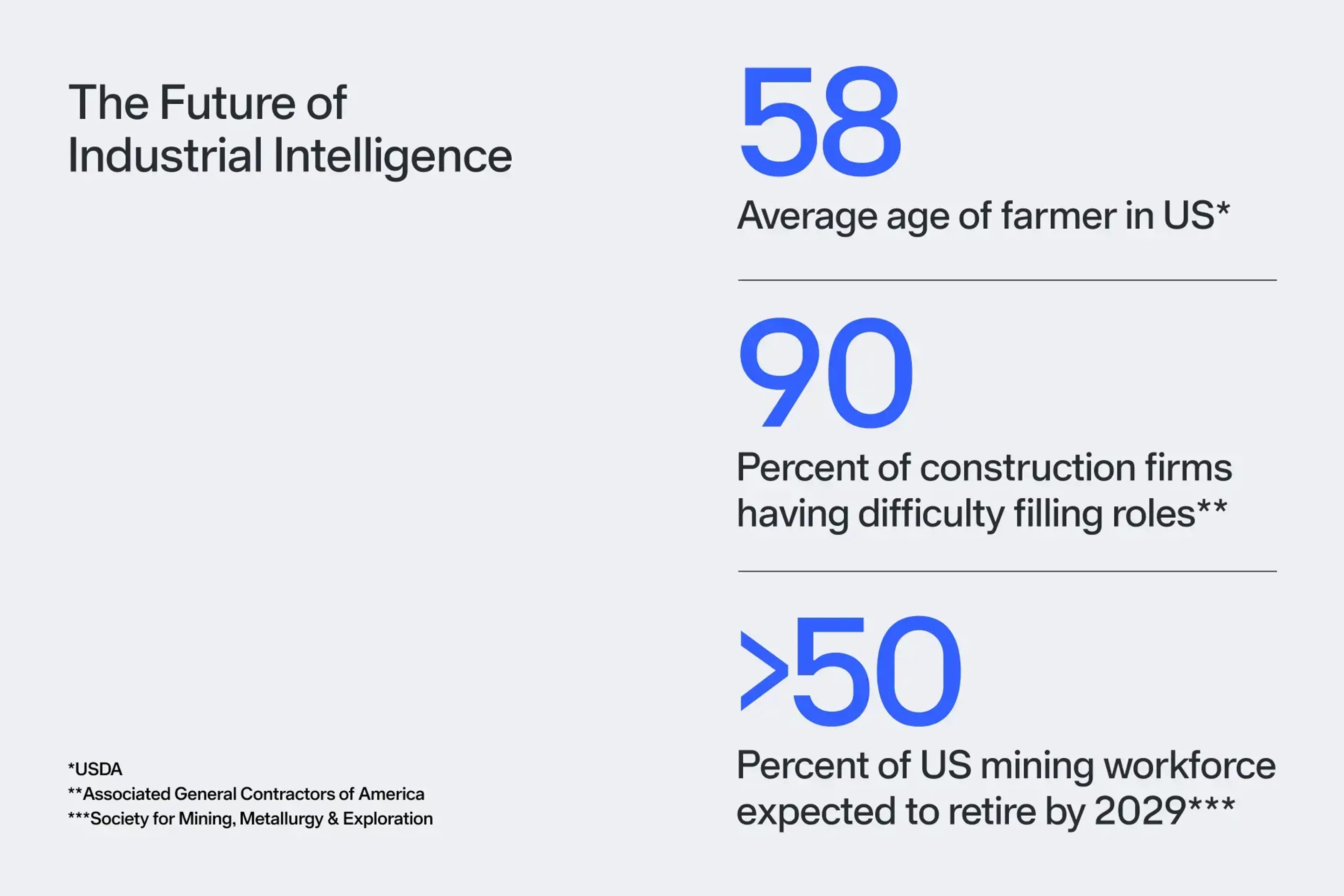
Across these industries, the biggest ongoing challenge is a persistent shortage of labor. The average farmer age is 58 years old and less than 10 percent are under the age of 35. In 2026, the construction industry will need nearly 500,000 new workers, and surveys show that over 90 percent of construction firms are having a hard time filling qualified roles. More than half of the U.S. mining workforce, approximately 221,000 people, is expected to retire by 2029, while demand for critical minerals will double by 2030.
If we don’t solve the labor shortage problem, it could result in food shortages, stalled infrastructure development, a worsening housing shortage, and a bottleneck for the green energy transition, to name a few examples.
JF: At Applied Intuition we are solving them in two ways. First, we are driving change that will entice more people to enter these industries. Second, we are helping the industrial sector embrace autonomy to fill the labor shortage, looking at how to empower fewer people to get more done on a job site.
So, how do we bring more people into the industry? If you sit in the cab of a tractor, wheel loader, or haul truck, you’ll see that it hasn’t significantly evolved in decades. A high-precision ag tractor can have multiple screens, with the right side full to the brim with physical buttons and clunky user interfaces. Older farmers have grown comfortable with how this cab looks and feels. But for young people new to the industry, it can feel overwhelming and complex.
Applied Intuition is developing our Cabin Intelligence product to help solve that. Last year, we announced with Stellantis how we will change the experience for drivers. Now, we’re applying that same approach to make heavy equipment intuitive for today’s operators.
Our Vehicle OS provides the software architecture that enables the software-defined vehicle for industrial use, completely transforming how the operator interacts with the machine. Displays are cleaner, simpler, and more intuitive. Voice assist improves ease of use. Automation can significantly reduce the number of physical buttons needed. Cabin Intelligence can not only attract more operators into these industries, it can make them more productive, more quickly—reinventing what it means to operate a machine.
JF: By transforming the cab of any industrial vehicle into an intelligent command center, Cabin Intelligence brings machine health, site context, and operator controls into a single, adaptive interface that improves safety and increases productivity. Displays become cleaner and more consolidated. OEMs centralize control into one screen. Voice assistance introduces natural interaction. Automation features help reduce reliance on sprawling physical controls. It makes the vehicle as easy to use as a smartphone.
JF: Embracing autonomy is the other key to helping solve labor shortage.
It is not about taking people’s jobs away. Large general contractors have reported turning down billions of dollars of work due to an inability to find labor. So the goal of autonomy in these industries is to help operators do more with less.
Last year, Applied Intuition announced our strategic partnership with Komatsu. As part of that partnership, we will be working with Komatsu to develop its next-generation autonomous haulage system. The solution will bring our vehicle intelligence capabilities to Komatsu’s mining fleet.
In addition to mining, we are focused on autonomy for both agriculture and construction. In construction, for instance, jobs such as building solar farms and data centers can be automated. Autonomous vehicles can help flatten and prep sites for solar farm installation, then deliver material around the site, because it’s repetitive work. You’d need only one person with an iPad controlling five to ten pieces of equipment.
JF: Quickly. As soon as companies in the farming, trucking, mining, and construction industries are ready to begin integrating this technology, the economic impact should be almost immediate. If you think about it, unburdening these companies from labor issues should allow them to be much more productive and efficient, which will translate into economic growth.
What’s unique about Applied Intuition is that we have the end-to-end capability to do this quickly. We've been doing this in vehicles for a long time—Applied started as a tooling company. Our tooling and multi-vertical software platform allows us to develop, test, and validate customizable autonomy solutions at an industry-leading pace.
JF: Every piece of heavy equipment will be fully autonomous. Each mining, agriculture, and construction site will operate with fully automated fleets.
On a farm, for example, you might see autonomous combines and grain carts cut, transfer, and unload crops through the night with no operators in the field. For a new data center project, autonomous excavators, haul trucks, and dozers will dig, move, and grade the earth based on a digital site model. In a mine, autonomous drills, loaders, and haul trucks will coordinate the blast pattern, excavation, and material movement in a continuous, optimized flow, keeping the entire operation running safely and efficiently, 24/7.
It’s exciting to be laying the foundation for this world today, and I can’t wait to see the first fully autonomous job site. It’s not a matter of if, but when.