Building for Scale: Cloud-Native HD Maps for Autonomy Simulation
Autonomous vehicle simulation demands HD maps that scale. This post explores the technical evolution from monolithic files to cloud-native, tiled architectures. Learn how distributed services, parallel ingestion, and incremental migration practices doubled simulation throughput while cutting infrastructure costs. Real-world results show how scalable HD mapping powers the future of autonomy testing and safety validation.
Benjamin Cooper, Nathaniel Vaughn Kelso, Ryan Tarr • January 16, 2026 • 7 min read
Simulation teams in autonomy confront the challenge of scaling HD mapping infrastructure to support ever-growing simulation volumes and expanding geographic coverage. At the same time, they need those maps to serve as a high-fidelity digital twin of the real world, so simulation remains valuable even as onboard HD maps fall out of favor. Legacy systems struggle with massive files and centralized services. These systems slow workflows and create unpredictable resource demands. As autonomous driving ambitions accelerate, engineering teams contend with rising complexity and scale in the map data needed for comprehensive testing and faster iteration.
High-definition (HD) maps provide the backbone for autonomous vehicle simulation and safety validation. To understand why, it helps to contrast them with standard definition (SD) maps familiar from consumer navigation apps. Those offer basic road geometry and routing — sufficient for turn-by-turn directions but lacking the detail needed for realistic virtual testing and lane-level autonomy. HD maps, by contrast, deliver centimeter-level precision, mapping lane boundaries, elevation changes, and semantic details that capture every nuance of complex urban environments.
An earlier blog post explored hybrid SD/HD mapping strategies, highlighting both how combined layers advance ADAS and autonomy use cases and how difficult it is to maintain HD maps onboard a vehicle stack at scale. That post also showed how hybrid approaches help teams lean more on SD data in production while still using HD context where it matters. Building on that foundation, this post takes a deep dive into the technical journey of building a cloud-native HD map architecture for simulation: how scalable, realistic simulations come to life, what engineering teams have learned from migration, and the direction of mapping innovation. It covers the evolution of map servicing architectures, key cloud-native principles, best practices from recent migrations, and real-world results. Together, these insights help drive mapping technology forward.
Mapping Architecture Evolution and Technical Innovation
Early autonomous systems relied on monolithic HD map files. These assets quickly reached limits in scalability and flexibility. SD maps offer compactness and ease of updates but fall short in supporting critical features such as lane following or complex simulation scenarios. Although HD maps deliver greater precision, multi-gigabyte file sizes make scaling difficult, particularly for highway programs that need full-fidelity cross-country routes.
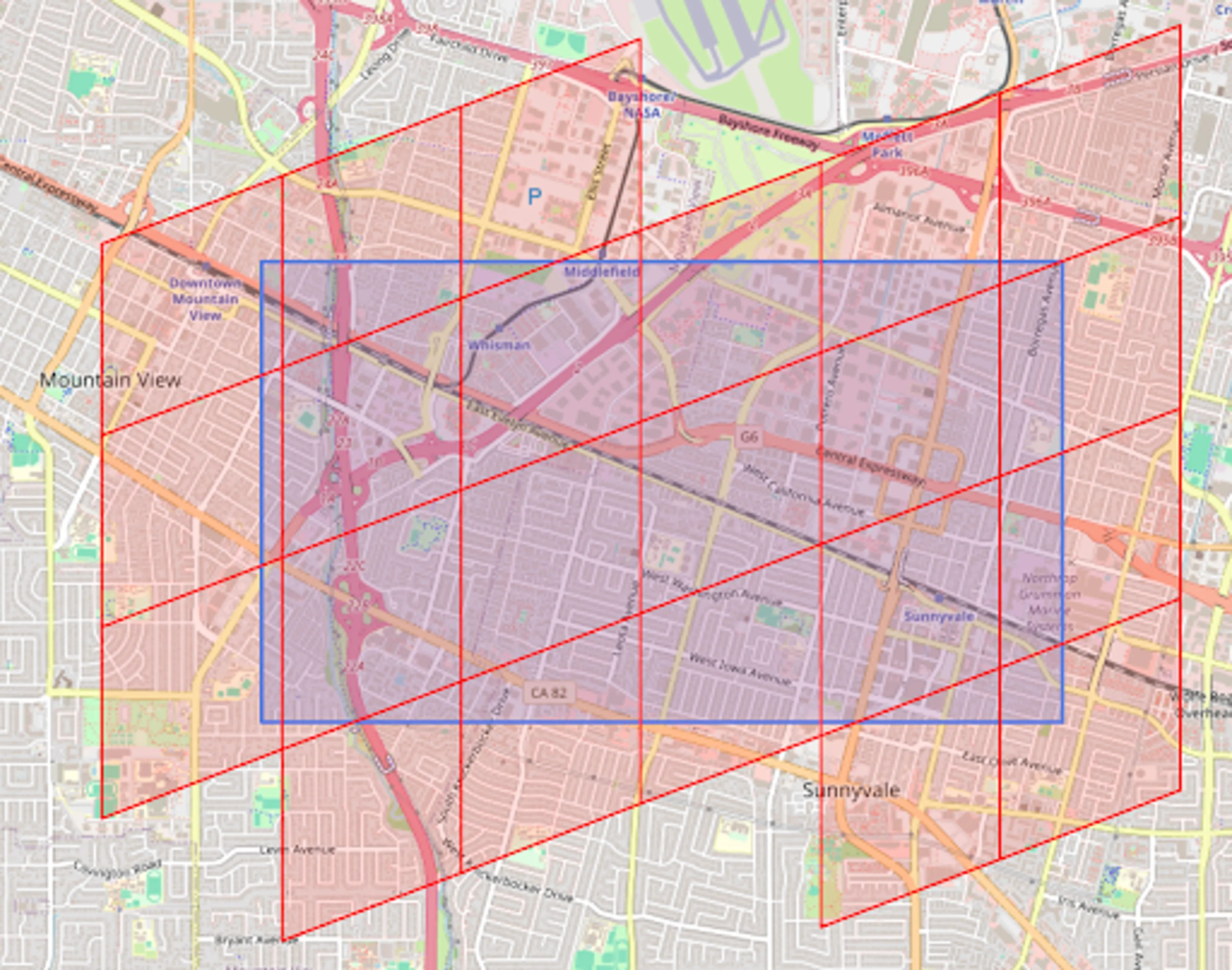
A map of Sunnyvale represented as 22 individually queryable tiles, where it used to be a single monolith
Tiled HD mapping marks a turning point. By breaking one huge map into many small tiles, the platform can store, query, and update each region independently — much like game engines and real-time navigation systems that stream in only nearby world chunks. Applied Intuition uses Google’s S2 library to implement this tiling, dividing the world into a hierarchy of cells and assigning each cell a stable identifier that makes spatial lookup fast and efficient. Storing tiles on cloud infrastructure has untethered map data from legacy file services and limited databases. Simulations of any size access only the relevant region, making global and cross-country scenarios practical.
Modular tiling enables hybrid and rapid-update solutions; individual tiles refresh or update without disrupting the system. As scenario coverage expands — from local routes to virtual miles spanning entire continents — the architecture scales.
Building for Scale: Cloud-Native Principles in Practice
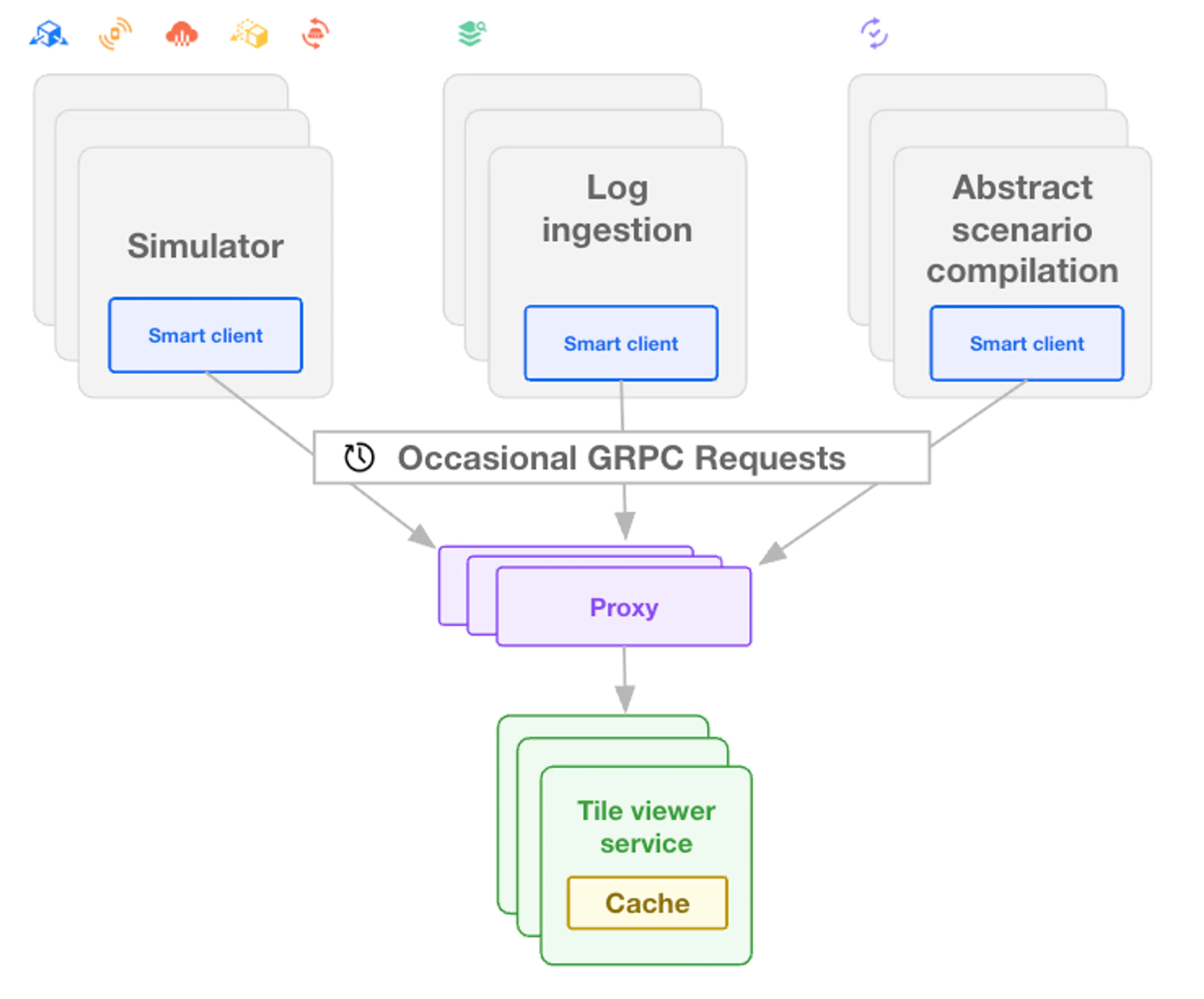
Moving HD maps to a cloud-native model requires distributed services and parallel workflows. The architecture separates storage from compute. Simulation nodes process only what they need and never load massive map files into memory. Instead, a “map as a service” design rules. The single-responsibility, horizontally scalable tile viewer service grabs just the required tiles from cloud storage (such as S3), reads them, and delivers the contents instantly to each simulation node.
Horizontal scaling, sticky load-balance proxying, and smart caching are key properties of the tile viewer service that enable high throughput for any ADP product depending on map data
Key building blocks:
Parallel map ingestion: Up front, the system generates and assembles map layers — vector, terrain, semantic layers, etc. — by kicking off parallel ingestion jobs that run asynchronously.
Proxied tile viewer service: Sitting between storage and simulations, this proxied service smartly caches high-traffic tiles, routes requests efficiently, and relies on sticky load balancing to let repeated queries reuse tiles in memory.
Resource efficiency: compared to the previous system, a high-traffic customer saw a ~99% reduction in map-serving related compute costs.
With this model, teams can launch targeted tests in a single neighborhood, run a million simulations a day worldwide, or extend coverage to meet any customer’s needs. By turning map data into tiles and building parallel pipelines, engineering teams transform resource bottlenecks into chances for continual optimization.
Migration Lessons and Simulation-Driven Best Practices
Applied Intuition’s migration to a tiled and cloud-native mapping stack surfaced key lessons for any engineering team building for scale:
Start with scale in mind. Proving correctness on a developer’s machine or a local cluster says little about how systems will behave with tens of thousands of concurrent simulations. Only real load tests expose the unique failure modes and bottlenecks that appear at high scale.
Precise instrumentation and robust metrics matter at every stage. Tracking usage data and workflow patterns allowed engineers to identify where backward compatibility really mattered — and where it didn’t. By focusing on features that drive customer value rather than legacy parity, teams accelerated delivery and simplified migration.
Rollouts work best when they’re gradual and measured. Rather than flip a switch for the entire customer base, Applied Intuition deployed cloud-native HD maps first to select customers. This approach limited organizational risk and created space for rapid iteration based on early feedback.
Simulation platforms pose unique requirements. Unlike navigation or ADAS, simulations demand maximum spatial fidelity, rapid iteration, and orchestration across varied scenarios. Modular, tiled HD maps enable specialized teams — validation, sensor simulation, mission planning — to request only the tiles they need, boosting both speed and accuracy.
These migration practices — prioritizing incremental rollout, gathering detailed metrics, and designing specifically for simulation needs — set a baseline for future innovation. As mapping technology continues to evolve, teams that build with scale and metrics at the core stand best positioned to deliver robust, adaptable solutions for autonomy.
Real-World Results and Industry Context
Cloud-native HD mapping has created measurable, lasting impact at scale. When Applied Intuition adopted architectural advances like S2 tiling and modular storage, several key improvements followed.
Simulation throughput doubled for many customers, unlocking the capacity to process millions of virtual miles in days instead of weeks. Teams saw infrastructure costs fall as memory footprints shrank and compute resources adapted dynamically to changing demand. Reliability improved in lockstep — simulation runs became more predictable, both in runtime and cost estimates. That consistency fuels engineering productivity and enables more confident resource planning.
These gains aren’t just theoretical. Applied Intuition customers have run massive scenario loads spanning continents and multiple teams, with distributed, tiled mapping eliminating bottlenecks and resource contention. The approach delivers tangible operational value — scenarios that once pushed up against technical limits now run smoothly, even at hyperscale.
Industry-wide, cloud-native mapping fits into a larger movement. While this post focuses on scaling simulation infrastructure, similar principles will underpin real-time SD/HD layer integration and dynamic map updates. As the pace of change in autonomous driving accelerates, modular tiling and efficient pipelines will support the rapid evolution needed for emerging vehicle fleets, AI-driven updates, and next-generation road conditions.
Autonomy programs that invest early in scalable, adaptable mapping lay the groundwork for innovation and resilience. The capacity to validate, update, and deploy complex maps across global fleets is fast becoming an essential differentiator for industry leaders
At Applied Intuition, these advances mean faster innovation cycles, broader simulation scenarios, and a welcoming environment for technical talent ready to tackle autonomy’s toughest challenges. Contact us to explore joining the Applied Intuition maps team.
Benjamin Cooper
Software Engineer
Benjamin Cooper is a Software Engineer at Applied Intuition focused on mapping and simulation infrastructure for autonomy. He holds a BS in Computer Science from Vanderbilt University and previously worked as a Senior Software Engineer at Convoy, where he specialized in developer experience and infrastructure.
Nathaniel Vaughn Kelso
Engineering Manager
Nathaniel Vaughn Kelso is an Engineering Manager at Applied Intuition focused on mapping infrastructure for autonomous driving. He holds a BA in Geography from Cal Poly Humboldt and brings extensive experience in cartography and geospatial engineering from previous roles at Apple, Snapchat, and Mapzen.
Ryan Tarr
Software Engineer
Ryan Tarr is a Software Engineer at Applied Intuition with a background in robotics, controls, and software engineering. He holds an MS in Mechanical Engineering with a focus on Robotics and Controls from Carnegie Mellon University and a BS in Mechanical Engineering from Rose-Hulman Institute of Technology.