Why Powertrain Diversity Is the Real Test of SDV Platforms
As EV momentum slows and hybrid demand rises, OEMs face a new challenge: building software-defined vehicles that seamlessly support all powertrains. Applied Intuition’s Vehicle OS provides a unified foundation that abstracts powertrain complexity, bridges legacy and modern workflows, and accelerates development across EV, hybrid, and internal combustion engine platforms—helping automakers stay competitive in a rapidly shifting market.
February 26, 2026 • 6 min read
After years of rapid electric vehicle adoption, a transition to EVs has stalled.
The implication for engineering leaders at automotive manufacturers is clear: With OEMs shifting their strategies from all-EV to mixed powertrains, the software-defined vehicle (SDV) of tomorrow must natively support all powertrains.
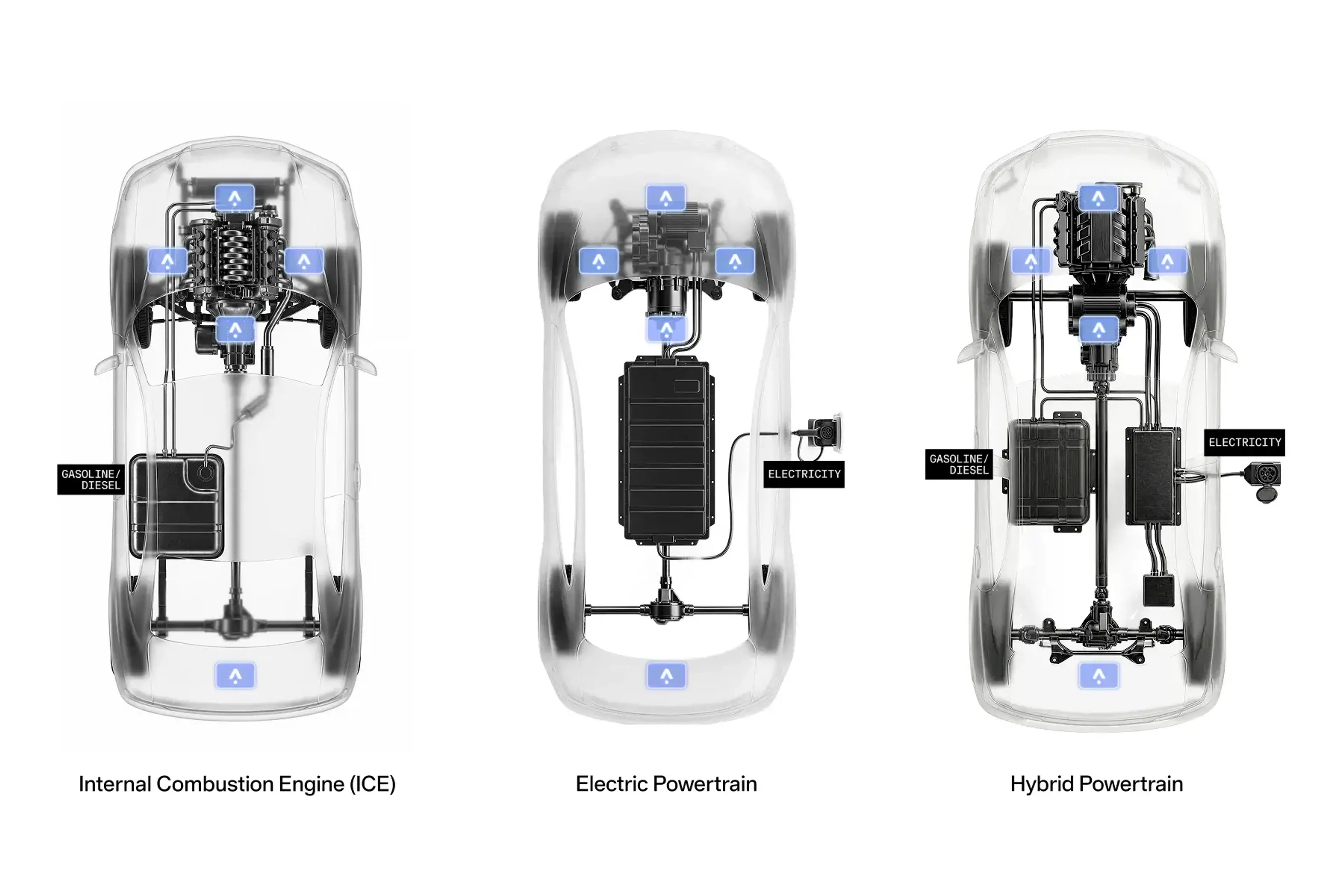
Illustration of internal combustion, electric, and hybrid powertrains
But this is easier said than done—and where Applied Intuition offers a unique advantage. By abstracting powertrain complexity at the OS level and unifying legacy and modern software workflows, Applied Intuition’s OS platform allows OEMs to rethink SDV adoption as a powertrain-agnostic strategy—one that spans EVs, hybrids, and combustion vehicles. By doing so, it can help OEMs accelerate vehicle development at a moment when time-to-market has become a critical competitive differentiator.
“We help OEMs deliver their unique brand look and feel across any powertrain,” says Will Lin, head of automotive at Applied Intuition. “And we achieve this with a much shorter time to SOP, while delivering a significantly richer feature set.”
The Complexity of Powertrain Diversity
Applied Intuition’s Vehicle OS was built for the realities OEMs face today: how to fast-track SDV adoption across powertrains, in addition to the more commonly considered autonomy, infotainment, cabin, and connectivity domains.
Unlike EV platforms that emerged with software-native electrical architectures and centralized compute, internal combustion engine (ICE) and hybrid vehicles were never born digital.
Instead, they evolved through decades of distributed control units, deeply embedded proprietary software, and hardware-first development cycles dominated by tier one suppliers. Traditional model-based design tools remain pervasive—useful for control-centric workflows but ill-suited to full SDV adoption. This has created a structural bottleneck for OEM teams trying to accelerate SDV development for ICE and hybrid vehicle development without rewriting their entire software stack from scratch.
Hybrid vehicles, in particular, are the most complex: They require high-capacity battery management systems alongside time-critical engine control loops operating at high frequency, often over legacy bus systems like CAN and FlexRay. The result is a system that demands real-time determinism, multi-domain coordination, coordination between safety and non-safety workloads, and strict regulatory compliance—all while preserving brand-specific user experiences.
Translating across EV, hybrid, and ICE platforms requires more than middleware integration—it demands a unified operating foundation that abstracts complexity without obscuring control.
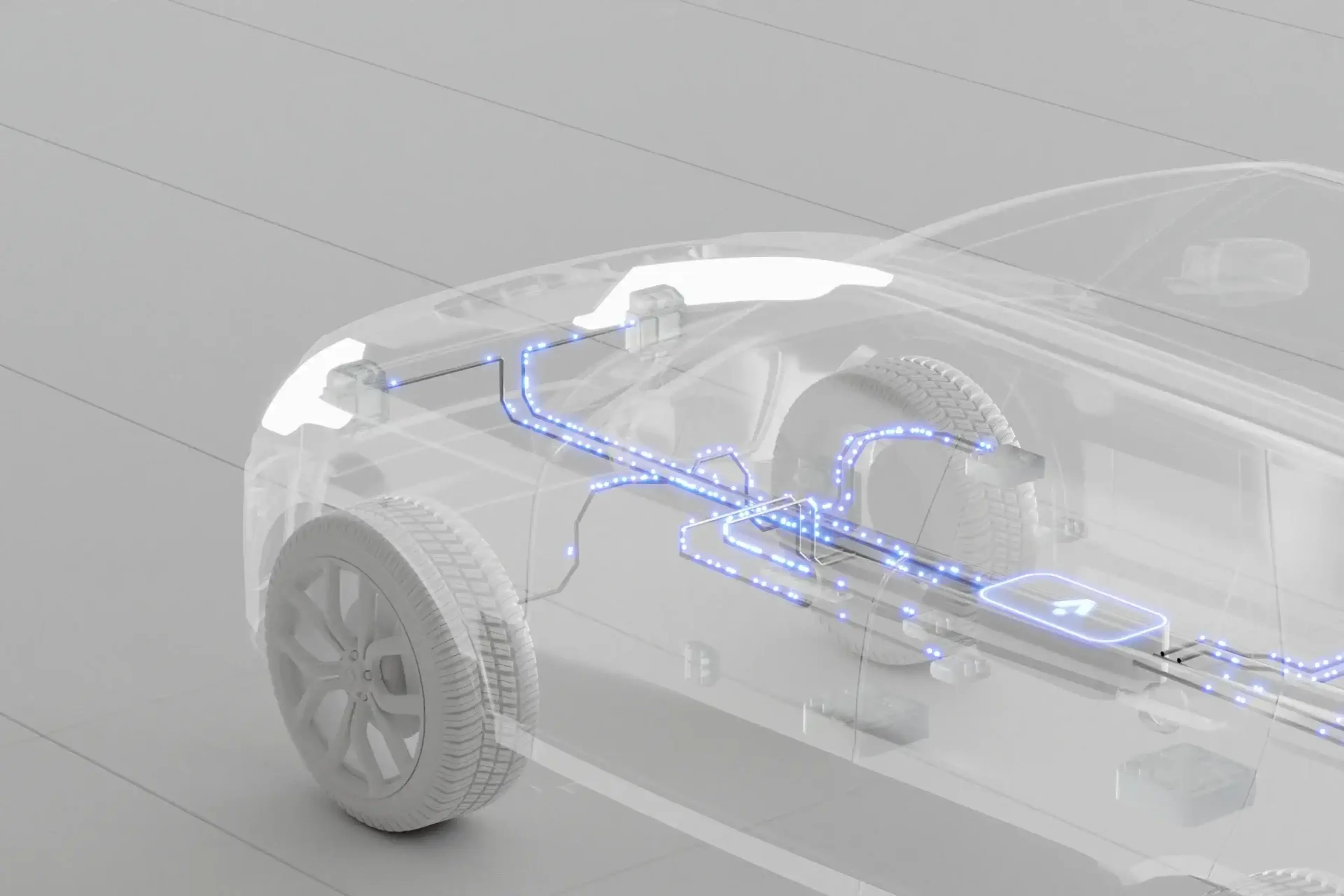
Electrical and software signals flow through the platform
A Unified Vehicle OS for Powertrain Diversity and Modern Engineering
Applied Intuition’s Vehicle OS is built as a software-first, hardware-agnostic platform grounded with both MPU and MCU compatibilities for predictable and performant process behavior, deterministic build systems that ensure reproducible outputs, and built-in observability that provides deep visibility into runtime interactions. Its unified, API-based architecture spans ADAS, chassis, infotainment, and platform services like OTA and data collection. This enables OEMs to treat the vehicle as a cohesive software platform rather than a collection of isolated ECUs and software stacks that are hard to integrate together.
One example of this architectural consistency making things easier is with complex ICE and hybrid environments, where support for legacy protocols such as FlexRay and compliance frameworks like OBD2 and SOVD must coexist with modern compute domains. These capabilities are not layered on retroactively; they are intrinsic to how Applied Intuition’s OS models and manages multi-domain vehicle behavior.
This foundation enables OEMs to treat vehicles—whether EV, hybrid, or ICE—as a cohesive software platform rather than disjointed hardware islands. Applied Intuition’s OS also distinguishes itself through the following differentiators:
White box on-board and off-board software solutions with reference hardware that allows for speed and scale
It spans multiple domains, including ADAS, infotainment, body, and platform services
Industry-leading developer tools enable rapid development and testing workflows
Hardware-agnostic interfaces enable reusable runtime environment generation across platforms
Applied Intuition’s OS APIs are compatible with AUTOSAR Classic and Adaptive, enabling OEMs to re-use existing applications for easy migration
Performance and Regulatory Considerations
One of the most potent advantages of a unified Vehicle OS is component reuse. While the core energy and powertrain functions for EV and ICE inevitably differ, many applications—from body control modules to suspension and window systems—share architectural commonality. By exposing high-level APIs that encapsulate domain-specific behavior, Applied Intuition’s platform allows these components to be reused across powertrains, reducing development duplication and accelerating product delivery.
Also, differences in power management between EV and ICE platforms create technical challenges that must be addressed at the OS levels. EVs often have large battery reserves and can support longer over-the-air (OTA) updates. ICE platforms must complete OTA patches in under 15 minutes to preserve starter reliability and minimize battery draw—a constraint that influences update packaging, power governance, and service orchestration.
These are not trivial engineering problems, and they demand an OS that treats diverse service requirements from the ground up, not as an afterthought.
Bridging Legacy and Modern Engineering Workflows
For many traditional OEM engineers, the transition from GUI-driven, model-based tooling to code-centric development represents a steep learning curve. Applied Intuition’s platform acts as a practical bridge between legacy and modern software practices.
Existing models and ARXML artifacts can be incorporated into a code-centric development environment where source code becomes the system of record, integrated with CI/CD pipelines, automated validation, and standard version control workflows. A code-first toolchain is also the stepping stone for AI workflows, which greatly accelerate efficiency and vehicle development.
Deterministic builds paired with comprehensive logging and observability give teams confidence in traceability and compliance while accelerating iteration dramatically. In traditional Tier-1-driven ecosystems, introducing architectural changes can take months due to validation cycles and opaque supplier processes. With a unified Vehicle OS and integrated tooling, those cycles compress to weeks or even days, enabling faster feedback, earlier validation, and more predictable time to market across every powertrain configuration.
The Operating Foundation for Powertrain-Agnostic SDVs
In a market defined by fluctuating EV demand, rising hybrid adoption, and renewed attention to ICE architectures, a software platform must be flexible, observable, and deterministic—not just powerful.
Applied Intuition’s Vehicle OS delivers this foundation, enabling engineering teams to unify workflows, accelerate validation, and confidently deploy across the full landscape of automotive powertrains. The future of mobility demands it—and the roadmap starts with the right software foundation.