Why Deterministic Execution in ADAS Middleware Matters—How The Action Graph Delivers Speed, Simplicity, and Reliability
Ensuring dependable ADAS simulation and log replay remains a technical challenge, especially when run across varying hardware and cloud environments. This post examines how Action Graph addresses these issues, enabling more reliable validation, repeatability, and performance for autonomous systems.
Robert Crane, Arun Nanduri • December 18, 2025 • 7 min read
For automotive software teams, the ability to simulate and validate autonomous vehicle behavior with repeatability and precision is not simply a convenience—it’s a necessity. In the pursuit of advanced driver-assistance systems (ADAS), developers and safety engineers need to understand exactly what their stack will do under every scenario, and ensure consistent behavior regardless of platform or run. Yet, achieving reliable and repeatable simulation results is a persistent challenge. Seemingly minor sources of randomness in traditional architectures—thread scheduling, inconsistent module communication, platform timing—can undermine debugging, coverage, and safety validation efforts.
Deterministic middleware addresses this challenge head-on. This post explores why determinism is critical for safe, scalable ADAS systems, what it solves, and how Applied Intuition’s Action Graph architecture raises the bar for performance, developer experience, and seamless integration.
This article is the first in a series on Applied Intuition’s Base Software Layer, focusing here on deterministic execution and the Action Graph.
What is Deterministic Execution in ADAS Simulation?
Deterministic execution means that the same scenario, when given identical inputs, the stack always produces the same outputs—even when the simulation or log replay is run multiple times. In ADAS development, this consistency ensures that testing is repeatable and results can be trusted. Random factors such as thread timing or message order are removed from the equation, allowing engineering teams to focus on system design and module behavior.
This consistency is essential for debugging, safety validation, and verifying system behavior. Without deterministic execution, even the same software deployed in identical environments can still yield unpredictable outcomes. The challenge is further complicated when simulations and log replay are executed on cloud resources or commodity hardware, which may differ significantly from the hardware found in vehicles. Achieving determinism ensures the system will perform identically across these diverse environments, eliminating difficult-to-trace bugs and making engineering results trustworthy. Determinism turns simulation and log replay into rigorous, reliable engineering tools, supporting faster validation and more confident development.
Why Does Simulation Noise Matter for ADAS Validation?
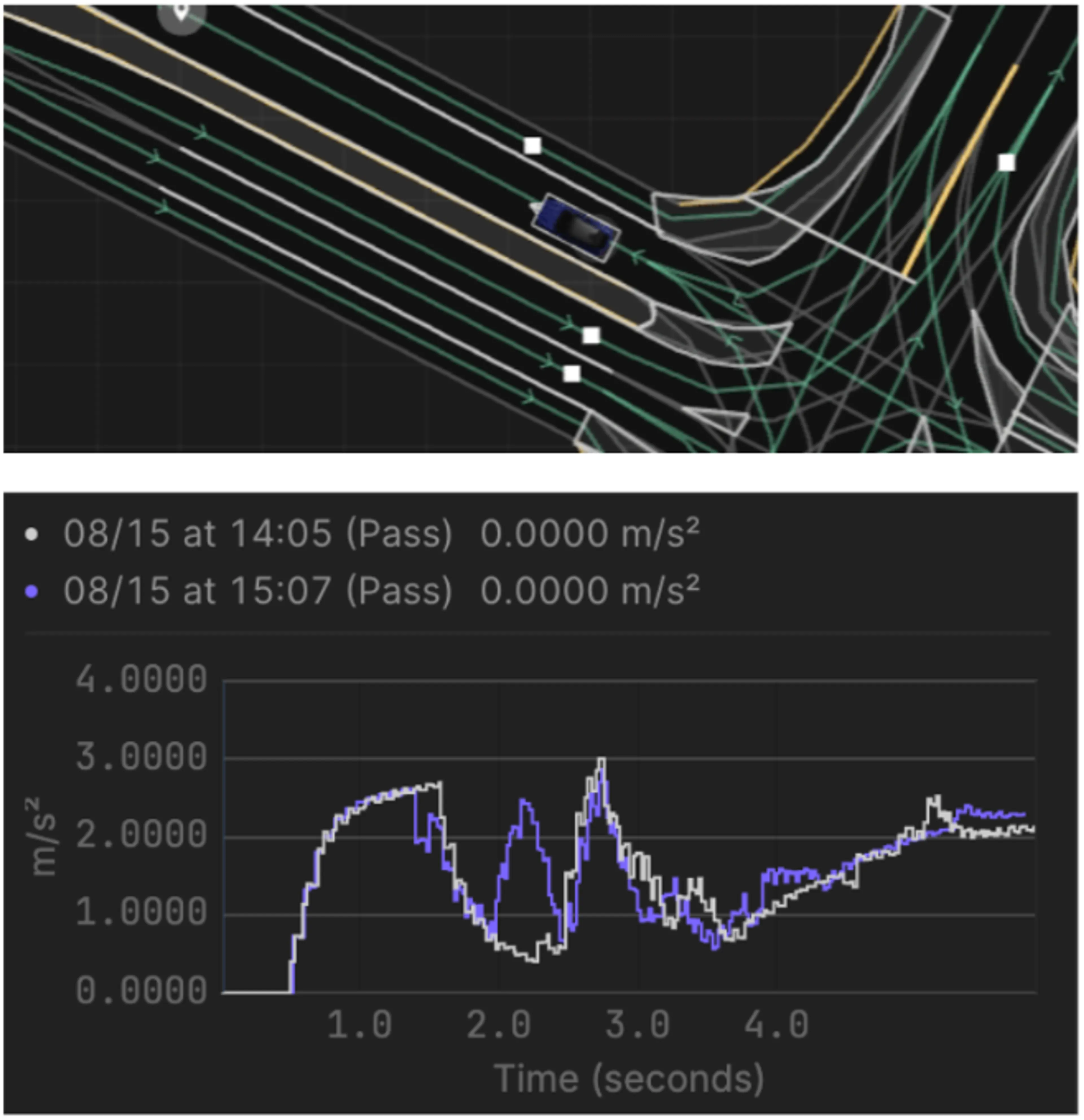
When replaying real-world logs or running synthetic scenarios, even subtle platform-level randomness can produce diverging traces. Graphs of vehicle trajectories, position, velocity, or acceleration aren’t always perfectly repeatable, despite identical starting conditions. This simulation “noise” means developers cannot always confidently tie changes in behavior to specific code changes, making root cause analysis much more difficult.
Nondeterministic Overlay (ego acceleration)
For autonomy stack engineers, this isn’t just a theoretical headache. The impact is felt every time debugging or safety case development requires verifying repeatable outcomes—whether it’s for regulatory approval or continuous integration and testing. If validation runs produce inconsistent results, trust in the development process erodes and timelines slip.
The root causes of non-determinism range from variable thread execution schedules and timing variations at the operating system level to unpredictable communication between stack modules. Even small timing differences—as seen when modules emitting messages at the “same time” reach a downstream consumer in varying order—introduce hard-to-track bugs.
What Deterministic Middleware Solves
Deterministic execution guarantees that identical inputs always yield identical outputs, eliminating system “noise” and making every simulation and replay a reliable source of truth. This property underpins the integrity of validation, code reviews, and safety certification—accelerating development by making bug isolation straightforward and tying system behaviors directly to design intent.
Architectures built for determinism from the outset—rather than relying on post-hoc, brute-force measures on legacy middleware—enforce clear communication order between stack modules and ensure inputs are processed in a consistent order. Deterministic execution uses pre-computed schedules and consistent initialization patterns to ensure simulation and log replay match real-world expectations.
Traditional middleware approaches (e.g., ROS-based stacks, ad-hoc “determinism patches”) tend to suffer from inefficient resource usage—forced serialization of critical paths or manual correction steps that slow simulation speed and can block parallelization. Deterministic-first architectures, such as Action Graph, optimize system resource usage by precomputing execution order, reducing idle times, and allowing modules to operate independently yet predictably. This leap in performance does not mean sacrificing reliability—on the contrary, it enables faster, high-fidelity development cycles.
The Broader Role of Middleware in ADAS
While deterministic execution is paramount, middleware in ADAS is also the “glue” that binds autonomy stacks together—handling communication, data serialization, orchestration, and fault tolerance. Every autonomy stack needs middleware, but maximizing its value requires solutions that prioritize architectural simplicity alongside performance and reliability.
Applied Intuition’s middleware’s design not only simplifies code reuse and ensures hardware independence, but enables developers to focus on higher-level engineering problems. Solutions like the Action Graph stand out by baking determinism directly into their communication and scheduling fabric, making high-fidelity simulation and validation a practical reality.
Applied Intuition’s Approach: The Action Graph Advantage
Applied Intuition’s Action Graph advances simulation fidelity and engineering efficiency by embedding determinism and transparency directly into the architecture. Rather than adapting legacy frameworks, this solution builds in explicit module connectivity, predictable execution order, and streamlined integration from the start. By emphasizing architectural clarity and reliable workflows, the Action Graph unlocks a range of technical and practical benefits for ADAS development teams.
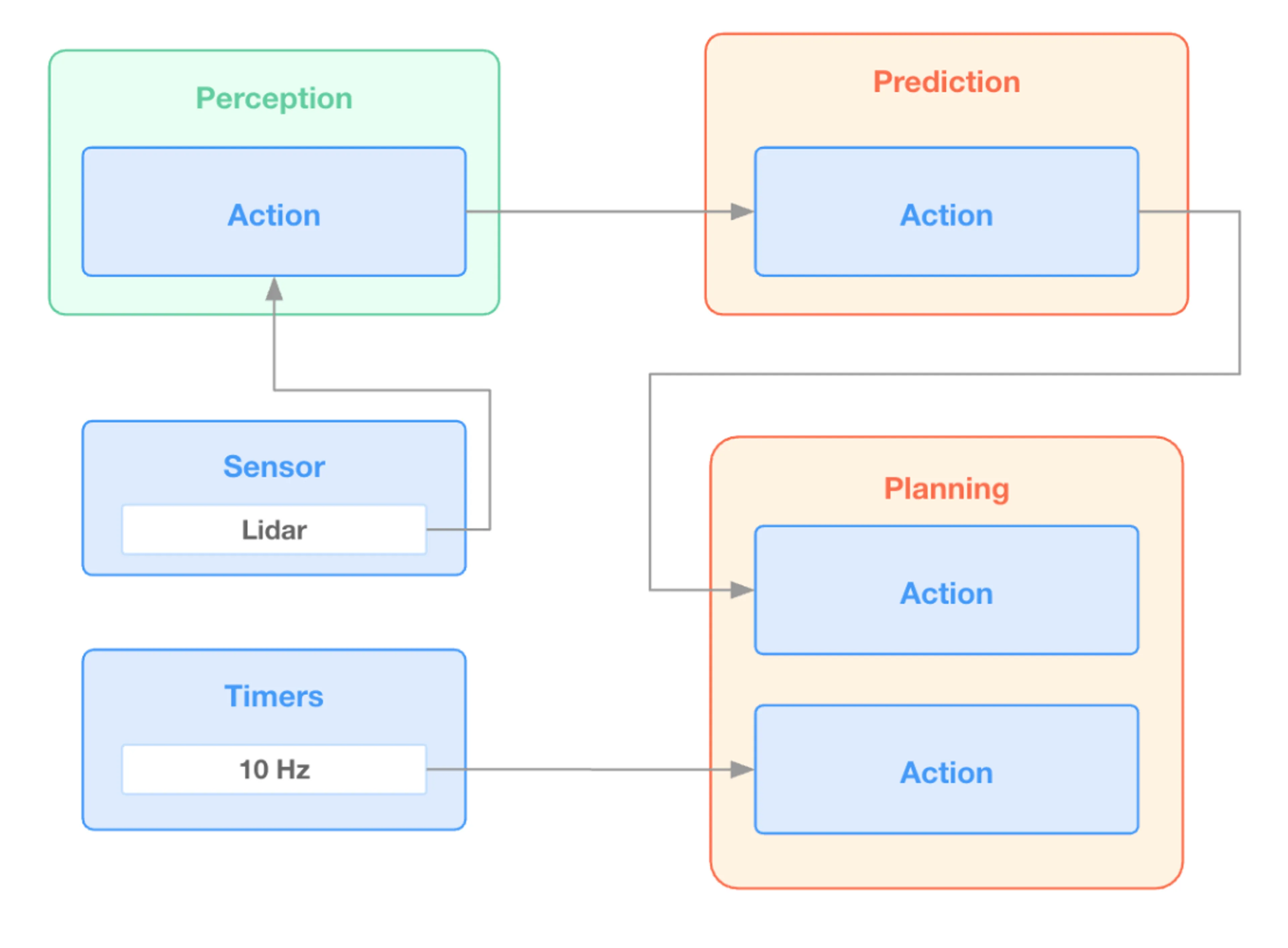
The Action Graph explicitly shows how the outputs of each component's actions feed into the inputs of other actions
Explicit, Modular Design
The Action Graph delivers determinism and efficiency at the architectural level by requiring explicit modeling of module connectivity and execution order. Each component in the autonomy stack must declare how it talks to others and how its data flows, with pre-computed schedules guaranteeing repeatable results. This explicitness clarifies system structure, revealing interdependencies and simplifying analysis for engineers.
Superior Consistency and Debugging
With repeatable outcomes for every simulation and log replay, the Action Graph supports faster bug isolation and validation cycles. Test cases become reliable benchmarks for safety certification, and simulation noise is reduced to zero—empowering teams to iterate and triage with maximum confidence.
Accelerated Development and Performance
By enforcing deterministic scheduling and communication, the Action Graph enables efficient parallelization while blocking for only the minimum time needed to maintain deterministic execution. Modules execute as their inputs become available, but, if needed, the system forces them to block for exactly the time required for the rest of the system to “catch up” in order to guarantee repeatable results. This careful coordination leads to reduced idle times, streamlined scenario execution, and substantial gains in simulation speed without sacrificing accuracy.
Improved Developer Experience through Explicit System Modeling
Forcing developers to explicitly model the system is itself a benefit. This requirement promotes transparency and imposes a clear, internal communication structure throughout the autonomy stack. The result is an easier system to understand, maintain, validate, and extend—a decisive advantage for teams scaling their platforms or onboarding new engineers.
Seamless Integration with ADP (“Sim Bridge”)
Applied’s custom integration for the Action Graph and the Applied Development Platform (ADP), via the sim bridge, provides customers automatic deterministic execution for both simulation and log replay. No additional setup is required; customers realize all the benefits instantly, making deterministic execution accessible and usable “out of the box.”
How Does Action Graph Deliver Reliable Log Replay?
Determinism isn’t just for simulations. The Action Graph’s architecture makes log replay equally reliable and repeatable—a crucial benefit for teams relying on real-world data to debug new features, validate fixes, or reproduce edge cases from production runs.
Collectively, these advances mean faster onboarding, less manual debugging, more predictable integration across diverse hardware, and streamlined paths from prototype to safety case certification. Applied Intuition’s focus on developer ergonomics and seamless customer experience delivers actionable, daily value in engineering workflows.
How Can Engineering Teams Accelerate ADAS Workflow with Deterministic Middleware?
Deterministic execution unlocks speed, safety, and confidence in ADAS software workflows, forming the foundation of scalable autonomous vehicle development. Middleware designed for determinism and performance drives down error rates, reduces physical testing costs, and accelerates go-to-market times for safety-critical applications. The Action Graph exemplifies this modern approach, enabling teams to deliver clear, repeatable, high-fidelity ADAS simulations, and reliable log replay out of the box.
Ready to Improve Your ADAS Simulation and Log Replay? Explore how Applied Intuition’s Action Graph and middleware can improve your ADAS development process. Contact our engineering team to learn more.
Robert Crane
Software Engineer
Robert Crane is a Software Engineer at Applied Intuition, focused on autonomous vehicle development. He holds a BS in Computer Science from the United States Naval Academy and an MS in Computer Science from Johns Hopkins University, and previously worked as a Software Engineer in Planning and Control at Zoox. He served as a Nuclear Submarine Officer in the US Navy.
Arun Nanduri
Software Engineer
Arun Nanduri is a Software Engineer at Applied Intuition focused on middleware and behavior planning. He holds a BA in Physics from Princeton University and previously worked as a Staff Software Engineer at Aurora focused on simulation for motion planning and controls.