The U.S. Navy’s Data Engine: Building the Infrastructure for Maritime Autonomy
Applied Intuition’s Data Engine jumpstarts autonomous capabilities by collecting training data via passive navigation capabilities installed on existing U.S. Navy ships.
The United States Navy faces a fundamental challenge in fielding autonomous and AI-enabled systems: generating high-quality, operationally-representative data to train, test, and validate its systems. Unlike commercial autonomous vehicles that can accumulate millions of miles with geofenced test fleets, military systems must learn to operate in environments that are difficult to replicate and constantly changing.
This is the problem Applied Intuition’s Data Engine was built to solve. Data Engine is the infrastructure layer that helps collect operational data, curates it, and trains perception models. It then evaluates and deploys those models back to vessels over the air, and the result is what one ship learns now reaches the entire fleet – a threat encountered by a single vessel is turned into an improved model and deployed over the air, so every ship can detect it. Applied Intuition was recently awarded a contract with the U.S. Navy to scale Data Engine across the fleet.
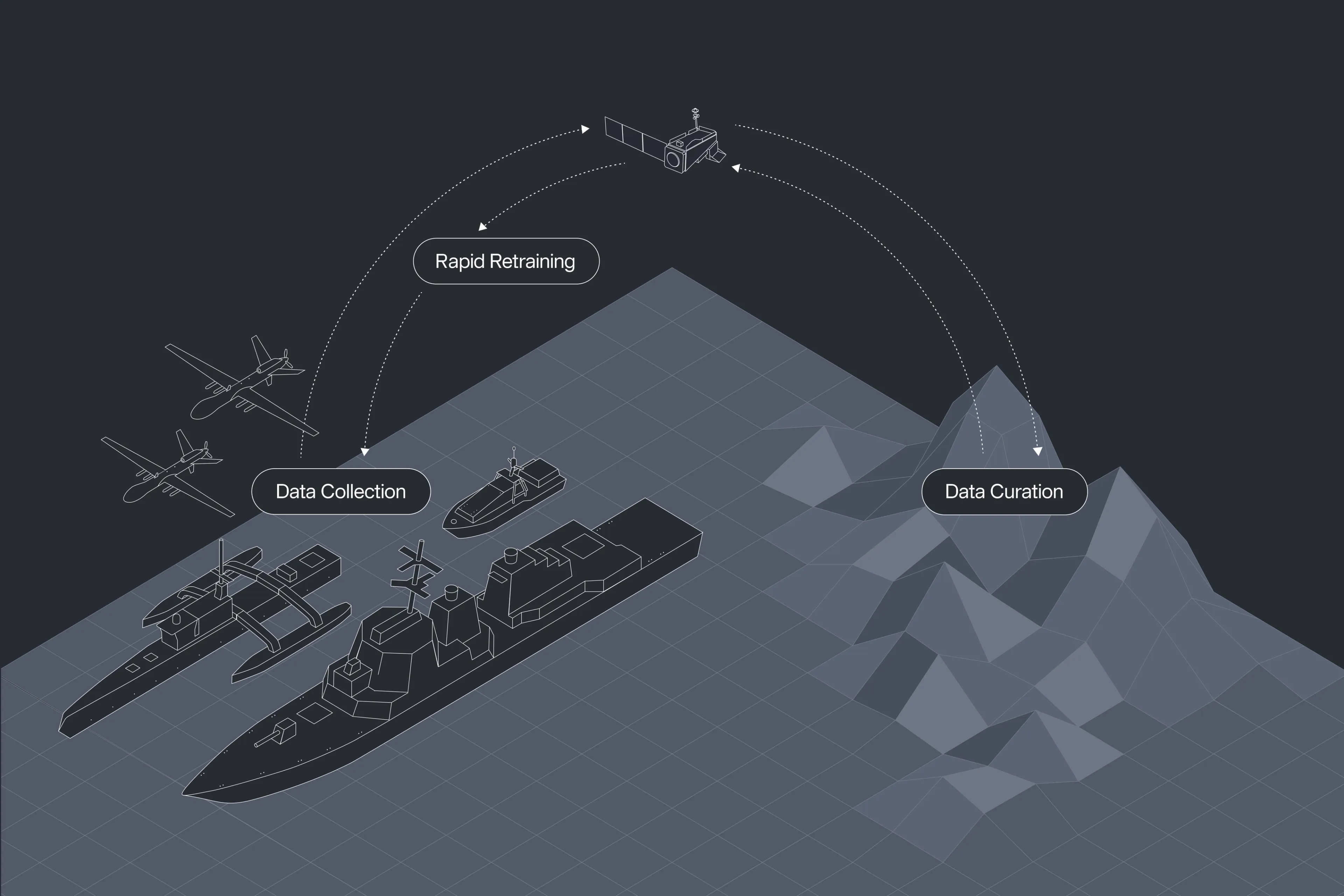
Data Collection: Shipboard sensors detect and record what ships and drones encounter, passively.
Data Curation: The most useful clips are automatically selected and sent ashore via satellite.
Rapid Retraining: Models are improved ashore, then ships are updated over the air.
Future conflicts will be won by nations that can field autonomous capabilities faster and more effectively than their adversaries. That requires infrastructure that can continuously collect data from operational environments, train models on that data, and deploy improved capabilities back to the field—and do it at a pace that keeps up with rapidly evolving threats.
For decades, the Navy has collected vast amounts of data from its ships, sensors, and missions, but lacked an organized infrastructure to log and aggregate that data, relying instead on ad-hoc methods. Even today, individual programs collect data for different purposes, each with its own logging standards and host environments.
While at sea, naval vessels operate with thin, intermittent satellite connectivity and must minimize electromagnetic emissions during operations. Crews face constant decisions about which clips are worth the bandwidth. Useful data means footage of other vessels, not hours of empty water. It also means that anything not sent over satellite during deployment must be manually collected when the ship returns, creating delays that can stretch for months—and that data is often archived or discarded rather than leveraged for training. As a result, countless hours of valuable sensor data from operationally-relevant environments do not contribute to the insertion of new autonomous capabilities.
Even when good data exists, a perception model starts to decay in usefulness the moment it’s deployed as conditions change, mission requirements evolve, and adversaries adapt. A threat one ship has already encountered can go undetected by another, because what the first ship learned never reaches the fleet. The Navy needs infrastructure that can deploy new and improved capabilities back to the entire fleet at a pace that keeps up with rapidly evolving operational demands.
“Autonomous systems live or die on training data, and the U.S. Navy has a severe scarcity problem—Data Engine is the infrastructure that solves it,” said Peter Ludwig, CTO and co-founder of Applied Intuition. “It’s the same continuous learning approach that made ground autonomy possible, now applied to an environment where the stakes are far higher. Every deployment teaches the next generation of systems.”
Applied Intuition’s Data Engine establishes an end-to-end framework for collecting and leveraging operational data to accelerate the development and deployment of advanced perception and autonomous capabilities.
The Data Engine integrates shipboard perception capabilities, scalable data collection solutions, and shore-based infrastructure to support the continuous improvement of AI/ML models across the maritime domain. Together, these capabilities enable the collection of diverse operational data, centralized data processing and model development, and the deployment of improved capabilities back to operational platforms.
This integrated approach establishes a continuous learning cycle, allowing maritime AI technologies to evolve through real-world operational experience while laying the foundation for increasingly capable autonomous systems.
Applied Intuition is building toward a future where each military service operates its own Data Engine, tailored to its domain and feeding into a common infrastructure. To learn more, visit applied.co/defense.