Digital Proving Grounds: Where Autonomy Earns Trust Before the Battlefield
Applied Intuition’s Digital Proving Grounds test multi-vendor autonomous systems at mission scale—virtually, continuously, and before hardware ships.
The military is moving quickly toward a future of autonomous systems: drones, boats, and ground vehicles that are capable of perceiving, understanding, and planning, often working in groups rather than alone. The shift is already underway.
Imagine a mission that requires hundreds of small drones, built with components from several different companies, to search an area for a hard-to-find target. Before anyone trusts those drones to cooperate in the real world, someone has to check that all the pieces work together—the cameras from one vendor, the navigation from another, the perception software from a third—and that the whole group behaves safely and effectively as a team.
Today, that validation usually happens by putting real vehicles in real places and seeing what happens. Physical exercises can cost hundreds of thousands of dollars per vehicle, happen a few times per year, and test just a fraction of the scenarios needed to ensure mission readiness. Integration failures surface too late—often during the exercise itself, when it’s most expensive to discover them. Each vendor builds in isolation, and the first time these systems communicate with each other is at the live event. As a result, the testing bottleneck has become the primary constraint on fielding autonomous systems at scale. Warfighters receive capabilities later than needed, and those capabilities arrive with unproven integration and collaboration behaviors. The mission requires better autonomous systems delivered faster.
Applied Intuition's Digital Proving Grounds (DPGs) address these concerns by offering an always-on, vendor-neutral simulation environment where teams can build, connect, and test autonomous systems virtually—and serve as the backbone for live testing when systems move from virtual to physical validation.
DPGs enable multi-vendor collaboration and support the full spectrum from pure simulation to hardware-in-the-loop (HIL) to live exercises, and the government gets a neutral platform for its assessment of third-party autonomous systems with continuous visibility into integration readiness. DPGs validate hundreds to thousands of heterogeneous agents across domains in a single simulated battlespace, compressing weeks of isolated test events into hours.
Each campaign contributes new scenarios, validated behaviors, and test data that become available to future programs. Applied Intuition has refined this approach over nearly a decade working with commercial autonomous vehicle developers—lessons learned from millions of simulation miles in the automotive space now transfer to defense applications, creating a dual-use advantage that accelerates the autonomy industrial base.
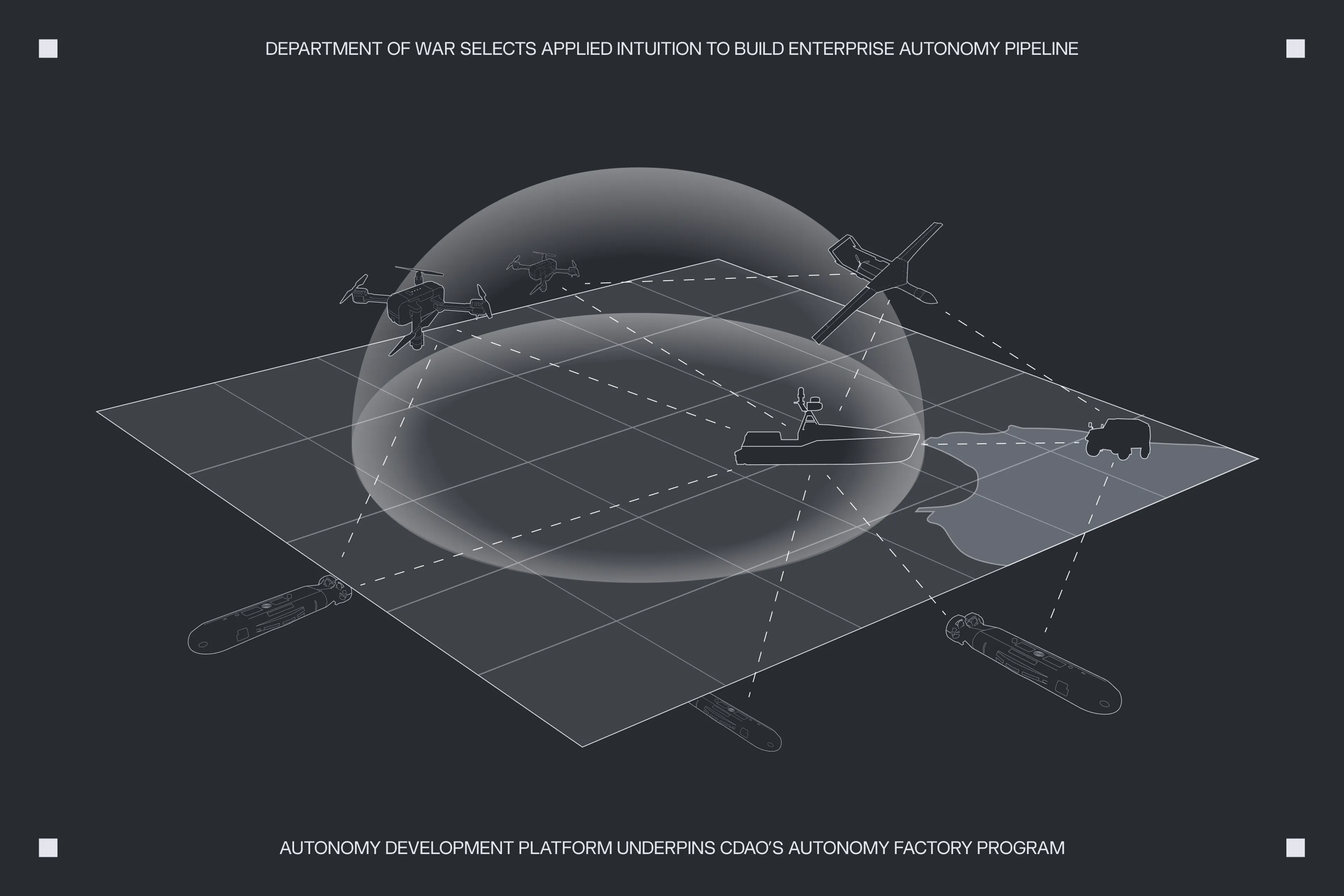
Recently, Applied Intuition partnered with the Pentagon’s Office of the Under Secretary of War for Research and Engineering on a DPG called Virtual Readiness and Experimentation (VREX). The goal was to test the integration of separate autonomous vehicles working in the air, on the sea, and submerged under water—all built by different companies, on a single unified mission.
As unmanned swarms have become a pillar of contemporary warfare, this is the kind of problem the military increasingly needs to solve, and it has a name: collaborative autonomy.
Developing collaborative autonomy behaviors is a different challenge from getting a single autonomous vehicle to operate well on its own, which is why the old way of testing is no longer sustainable. Checking whether a group like the one tested by VREX actually works together has traditionally meant flying dozens of engineers, plus the actual hardware, to a physical test site. It’s expensive to set up, which makes it possible only a handful of times a year, and often the big test itself is the first time these systems actually talk to each other, which can lead to embarrassing results or unforced errors.
This is the problem DPGs solve. DPGs move those first steps into a digital environment that’s not bound by the time, expense, and resource demands of a physical test site.
This DPG approach is now being scaled across the Department of War through the Chief Digital and AI Office’s Autonomy Factory program, where Applied Intuition’s platform will serve as a shared testing and integration infrastructure for DOW programs.
A DPG is the sim-to-live continuum that enables testing across a variety of fidelity levels:
VREX required a shared command and control interface for its different types of vehicles, which Applied Intuition supplied as part of the DPG, and it required a testing platform that could work quickly at real scale. DPGs fundamentally accelerate the find-fix-fly loop: when an issue is discovered during testing, teams can identify the problem, implement a fix, and refly the platform—all within an hour in the field, versus the weeks this process would have taken previously. The DPG compresses this critical iteration cycle into something fast enough to matter during live exercises. In the case of VREX, Applied Intuition operates the DPG, collaborating with vendors while military officials get continuous visibility into the integration process. The first major event saw dozens of government visitors across agencies witness a mission that successfully integrated surface and air vehicles across multiple vendors.
Every simulated run and every real-world event feeds back into a shared library of information. New problems that get discovered get added to future tests automatically, so the next round of testing is smarter than the prior one. Over time, this transforms the testing process from a series of one-off events into something more like a feedback flywheel; the system gets more reliable the more it's used, and each new test benefits from everything learned before it. This process continues as engineers begin to integrate physical components.
DPGs enable warfighters to receive reliable, more trustworthy capabilities. Traditional testing approaches meant systems often arrived in theater with undiscovered edge cases and integration issues that revealed themselves only under operational stress. With DPGs, systems arrive already having been tested through thousands of scenarios, with collaborative behaviors validated. The warfighter gets autonomous systems they can trust and which have already proven themselves before arriving on the battlefield.
In the old model, a test event produced a pass-or-fail result and then mostly got filed away. Because DPGs run continuously and keep memory of everything learned, testing becomes an ongoing source of insight that shapes both what gets built next and how quickly new capabilities reach the field.
DPGs close a loop between testing and development that used to be almost entirely manual and slow, ultimately delivering on two things that matter most: fielding more systems faster and delivering better capabilities to warfighters.
To learn more, visit applied.co/defense.