How Applied Intuition Made a Sprayer Autonomous in 30 Days
Applied Intuition retrofitted an existing 120-foot sprayer with its Self-Driving System, making it autonomous in just 30 days.
Fifteen tons. 120 feet wide. Booms swaying at 15 miles per hour and creating a bumper car effect in the cab.
The self-propelled sprayer is one of the hardest machines on the farm to turn autonomous, and yet it’s one of the most important to do so. Some 40 percent of global crops are lost to pests and disease every year, costing the economy a staggering $290 billion. Sprayers are essential for most farming operations: they allow large acreages to be treated quickly during tight weather or crop protection windows, which is crucial for optimizing crops. It’s also one of the only ways to control weeds in no-till farming. Driving one can be uncomfortable and dangerous. Operators face application exposure, heat, near-constant vibration, and rollover risk. Because of that, there are fewer and fewer skilled drivers able to operate them. Yet despite the clear case for autonomy, no existing sprayer, which can cost up to $800,000, had been retrofitted to run autonomously in the field and on public roads.
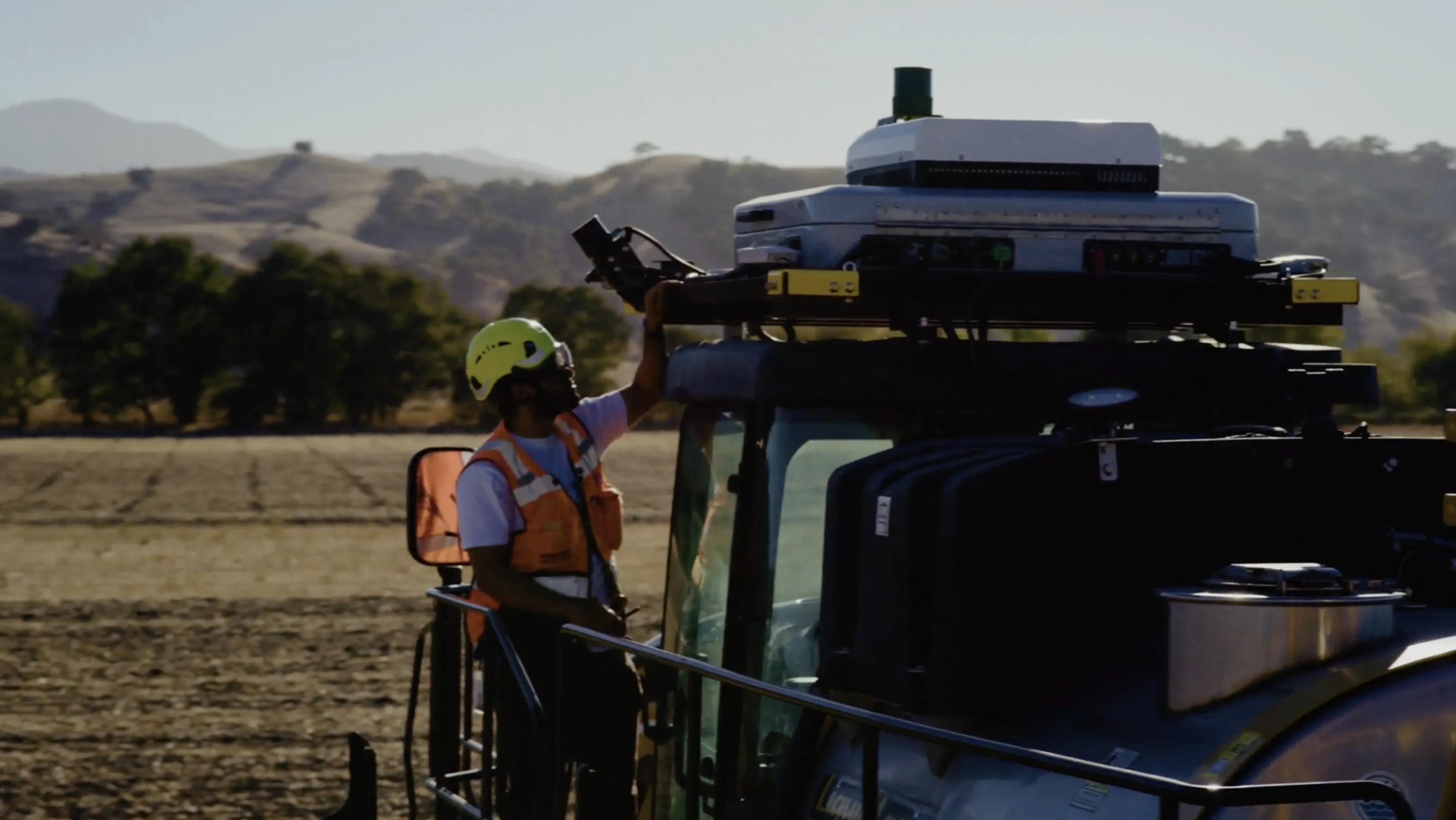
That’s the challenge a team of five Applied Intuition engineers took on recently, with only one working full time on the project. Using agentic AI workflows, they were able to turn a thousand-page technical manual into working knowledge in hours. They then connected Applied Intuition’s drive-by-wire controller to the sprayer’s electronic controls to command acceleration, steering, and booms.
In just one month, the sprayer was driving itself at our R&D test site, fields, and on private roads.
“Agriculture is one of the hardest places to have autonomy, and that’s exactly why it excites us,” said Bala Vinaithirthan, the engineer who led the sprayer integration. “The machines are enormous, and every manufacturer has its own control architecture, communication protocol, and actuation mechanism. A single vehicle might run on the road and a 1,000-acre field. Those are different operational design domains with different rules.”
Automating agriculture needs both on-road and off-road data to get the perception and planning correct.
“The drive-by-wire controller, the planners, and models came from our mining and on-road deployments, so we got to focus on what agriculture needs instead of rebuilding the basics,” he added.
The autonomy kit mounted on the sprayer runs on Applied Intuition’s Self-Driving System (SDS) for Agriculture, the same autonomy platform deployed at mining and construction sites around the world, and on vehicles operating on commercial routes in Japan and Europe. Roughly 70 percent of SDS is common across industries, with the remaining 30 percent built specifically for each deployment. As mining operations move toward production deployment, for example, agriculture inherits those gains.
On its own, an autonomous sprayer is a meaningful gain. It can run around the clock, and that 24-hour operating window can add 150 hours per sprayer each year, letting retailers and farming operations cover the same ground with fewer machines.
But a single autonomous machine is only part of the picture. The harder, and more valuable, problem is coordinating everything on the farm at once: the sprayer, the tender truck carrying water and chemicals, the human operators, and field-by-field routing decisions. Add real-time weather tracking, and growers can act before a threat like disease or a storm costs them their crop.
For example, last year an airborne fungus called southern rust hit Iowa. Some areas of the state experienced yield losses up to 40 percent, and growers that were able to spray fungicide were able to avoid major losses. Protecting fields from an event like that requires three things working together: predicting the outbreak from weather and disease signals, making sure the right fungicide is stocked in the right region, and having enough sprayer capacity available to act quickly.
There are also other important constraints that need to be factored in: wind speeds above 15 miles per hour make spraying unsafe and increase the risk of chemical drift onto neighboring fields. Rain within two hours of application can wash product away before it has time to work. And every crop protection product carries its own label restrictions on timing and rate. Farmers also judge the finished job by field-edge precision, whether the sprayer treated the boundary of a field accurately without overlap or gaps.
That’s the orchestration challenge SDS for Agriculture is designed to meet. Acting fast, though, means machines can’t stop at the edge of the field.
Getting the sprayer to drive in a straight line through a field is one thing, but fields are often irregularly shaped, separated by public roads, and surrounded by permanent fixtures like power lines, fences, and waterways. There’s also unpredictable obstacles: other vehicles, a person on the road, or an animal in the field.
Applied Intuition’s perception sensors, as demonstrated on the 120-foot wide sprayer, are built to detect and react to those obstacles in real time. Because SDS was trained in off-road environments, like mining and construction sites, as well as in on-road applications, like in commercial trucking, it unlocks a new potential capability for the ag industry: a sprayer, or other farm equipment, that can operate autonomously in both a field and on a public road.
Autonomous capability for farm equipment is still taking shape from a regulatory standpoint, but Applied Intuition has already worked through similar regulatory and certification questions in other industries, and will do the same for agricultural applications.
Large retailers that own thousands of sprayers can’t afford to replace entire fleets at high prices just to introduce autonomous operations.
Applied Intuition’s system is a retrofit kit, and is built to mount on equipment regardless of manufacturer. For large retailers and farming operations running mixed fleets across multiple brands, the OEM-agnostic system allows equipment that’s already operating in a field to become autonomous, significantly lowering the cost of entry.
Figuring out the sprayer solved part of the problem, but what about the edges of the field where it can’t reach? Fields are often irregularly shaped, with tight corners, narrow edges, and sometimes isolated pockets of farmable land that a 120-foot-wide sprayer can’t efficiently maneuver into. Applied Intuition is providing solutions to models using a real field boundary, running a simulation that identifies the specific zones a sprayer can’t cover well, and proposing a solution: mounting one to three drones on the tender truck (the vehicle that resupplies the sprayer with water and chemical) to cover those gaps while the sprayer handles the open ground.
The sprayer draws on Applied Intuition’s existing work pairing drones with ground vehicles in defense applications. For large retailers running mixed fleets, it points to a platform built not just to make one machine autonomous, but to coordinate multiple asset types, ground and air, on the same farm.
“The real vision is a connected field: drones and ground vehicles executing optimal prescriptions at sub-inch precision, and the fleet learning from every pass,” said Vinaithirthan. “Solving that is a serious technical problem, and it’s the kind we like to solve at Applied Intuition.”