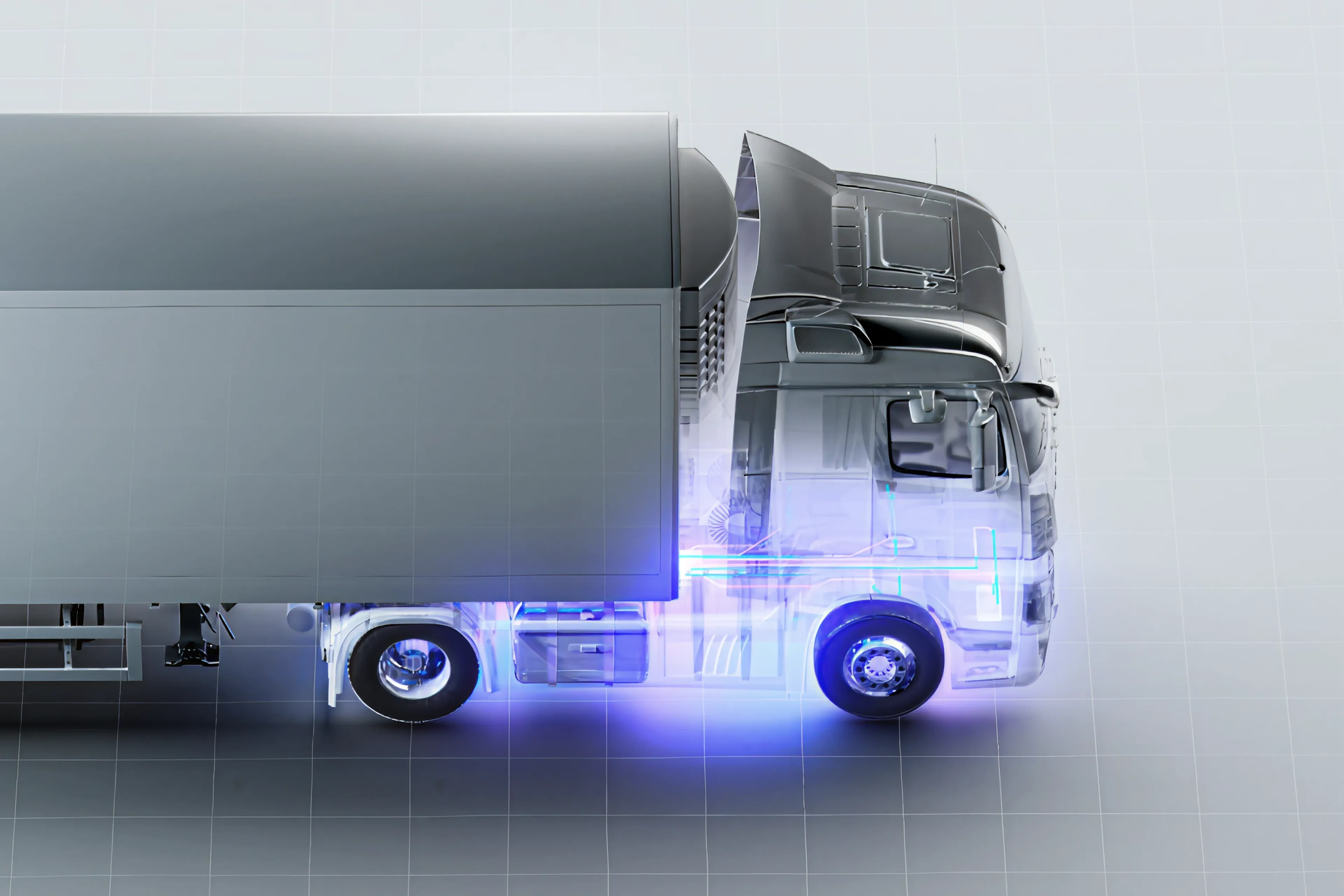
Within the first quarter after TRATON and Applied Intuition committed to building TRATON ONE OS together, nearly 200 TRATON engineers had been onboarded to the program and the teams were closing in on full integration of a driver display unit — in roughly ten weeks. What had started as a PC-like system demo was becoming real: prototype trucks heading toward winter and summer testing.
That pace and problem-solving capability is what’s possible when a fast-moving Silicon Valley startup and a 120-year-old industry leader decide to operate as one team.
“Most OEMs will tell you building an SDV platform takes years, and rightly so. These are complex, safety-critical systems, and they take time. This is also TRATON's experience,” says Abhishek Michael, partnership manager at TRATON GROUP R&D. “What has changed is not the problem itself, but how we've approached it. Working closely together, we've been able to move significantly faster.”
In May, Abhishek Michael and Georg Pinkert, senior program manager of Engineering at Applied Intuition, spoke about the partnership at the 2026 VECS conference in Gothenburg, Sweden.
“The problems we’re solving now—putting a full software stack on a commercial vehicle at production scale—aren’t problems any one company can solve alone,” says Georg Pinkert. “The sooner you find a partner you can work with this closely, the faster you move.”
Deciding How to Work Together Before What to Build
Getting to that point required building the partnership before building the product.
TRATON is an industrial monolith — 120 years of building things a certain way. Applied Intuition is a scaled-up startup—fast-paced, software-first, and operating with a different risk tolerance. Those cultures don’t automatically mesh. The two teams recognized that early on and addressed it directly, starting with two questions: Do we trust each other? And do we assume good intent when things go wrong?
The answers were yes and yes.
“We decided that before we talked about technology or contracts, we’d sit down and define the principles we wanted to work by,” says Abhishek Michael.
They didn’t start with mission statements. They focused on specific agreements: how decisions would be made, how disagreements would be handled, and what openness would look like in practice. Among them: Engineers on either side could choose the best solution without being tied to legacy components, and when necessary, select source code that could be shared.
That last point is rare: Both companies can request source code. They debug together and work in the same environment. That level of access made it possible to move quickly.
Decisions at the Lowest Level
TRATON ONE OS is a white-box modular architecture that combines TRATON’s internal development with Applied Intuition’s Vehicle OS for trucking. Working seamlessly together is critical to success.
One structural decision made a measurable difference in pace: the DRI system, or Directly Responsible Individual. For every area of the program, one engineer from Applied Intuition and one from TRATON are jointly accountable. Management sets direction and targets; engineers own execution.
The people making technical decisions were the ones building the system. The hierarchy was flat. Engineers could try something, see if it worked, and move on. Iterations happened daily instead of quarterly.
High Risk, High Reward
Alongside Applied Intuition, TRATON went from a system demo on a laptop to prototype trucks undergoing testing in 12 months.
“The bottleneck isn’t writing software—it’s integrating safety-critical systems with modern compute without breaking the vehicle,” says Georg Pinkert. “That’s where most programs slow down. TRATON ONE OS is what happens when you remove that friction.”
The goal is for all TRATON brands—Scania, MAN, International, and Volkswagen Truck & Bus—to run on a single operating system by the beginning of the next decade, forming the foundation for software-defined vehicles across the group.
“In many ways, we were finalizing the racetrack while the race cars already had a green light,” says Abhishek Michael. “We are invested in each other. There is no walking away.”